Tracking Student Fee Payments just got a lot Easier

Finance-Fedena
Monitoring and tracking student fee payments in an institution can be a daunting task for staff in your finance department. To help institutions always be aware of the status of student fee payments and the fee discounts, we have introduced the following three new finance reports as part of Fedena 3.3:

  • Batch wise Report
  • Fee Collection wise Report
  • Students wise Report

Only Fedena administrators and privileged employees (either the View Additional Reports privilege or the Finance Reports privilege must be provided) can view all three reports.

How to access the reports?

If you’ve been provided the View Additional Reports privilege, you can access the reports through the Reports module.

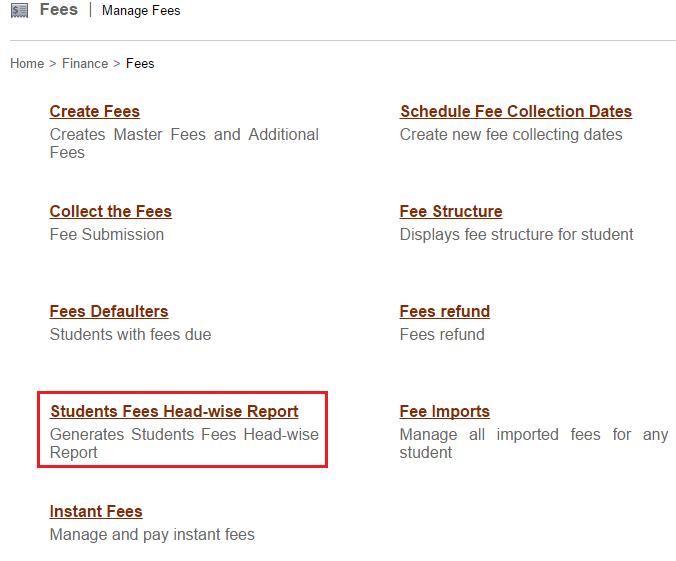
If you’ve been provided the Finance Reports privilege, you can access the reports through the Finance module – Click the module access icon > Administration > Finance > Fees > Students Fees Head-wise Report

1 2

Batch wise Report

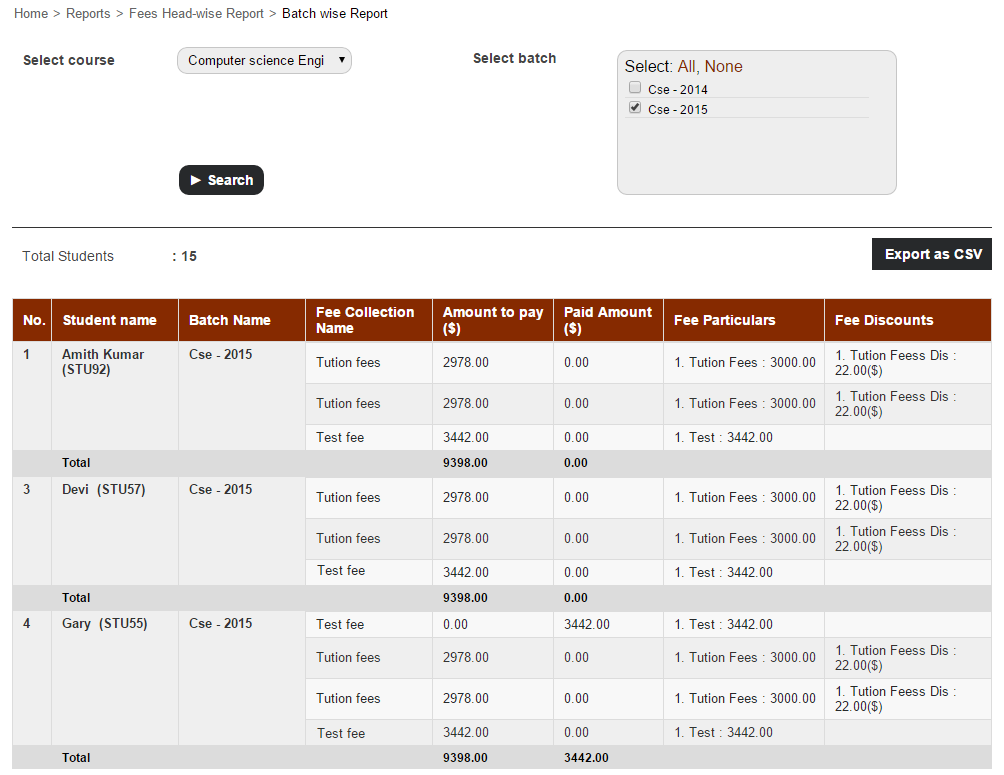
The Batch wise Report displays the amount of fees paid and due for each fee particular, by all students of the selected batch.

To view the report for a particular batch, select a course, and then select the batch and click Search.

3

You can also export the report details as a CSV file.

Fee Collection wise Report

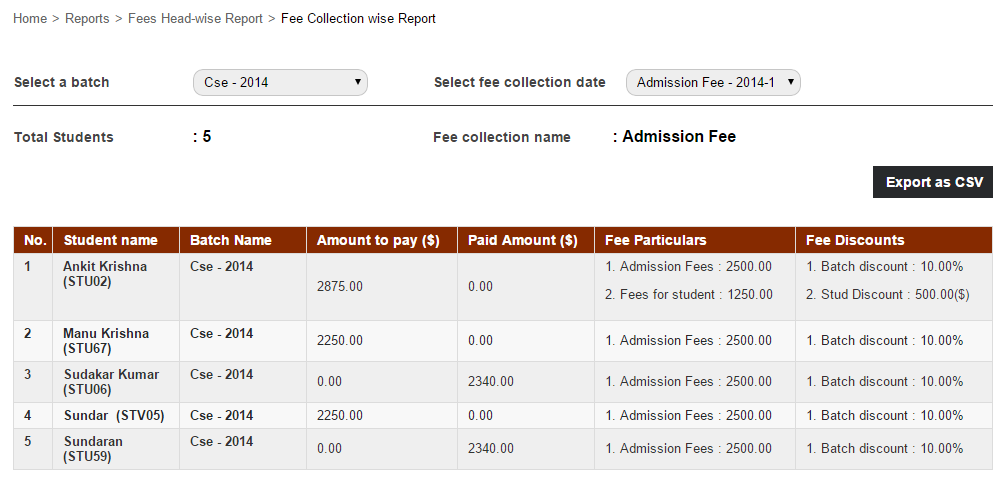
The Fee Collection wise Report displays the amount of fees paid and due for the selected fee collection, by all students of a batch.

To view the report for a particular fee collection, select a batch, and then select the fee collection.

4

You can also export the report details as a CSV file.

Students wise Report

The Students wise Report displays the amount of fees paid and due for each fee particular, by a particular student.

To view the report for a particular student, enter the name or admission number to search.

5

Now that you know how to use the student fee reports, use them to your advantage and track all student fee transactions with the institution and never let a penny slip through your fingers.

Guidelines to Improve Your Child’s Education

Guidelines

Education is one of the key components in a child life. For your child to have the best education there has to be teamwork, cooperation and collaboration between parents, teachers, and the child. If one party in this triangle is absent, then the child’s education is likely to suffer. As a parent, you have a key role to play in your child’s overall life. In his education, you are not just there for homework assistance. It is your responsibility to help your child gain confidence; good self-image and motivation which will help him achieve academic excellence. Even though you are already helpful and supportive to your child, here are some few ways to help your child grow academically.


Reading


You are your child’s first teacher. No matter how busy you are, set aside some time to read to and with your child. Reading to your child encourages him to develop a reading culture. Take some time during the weekends to discuss books, stories and events with your child so that you can test his memory. Start with easier books or short stories until you see that his thinking capacity expanded and start introducing him to biographies and easy to read history texts. Make your reading sessions interesting to always keep the child engrossed.


Teach him through daily experiences


Although the child learned a lot from school, there are so many more ideas that he could gain from home through his everyday activities. If he sees something and asks questions, do not just answer and shun him away. Develop the answers with him and make him understand so that he gains the ability to reason and think. Learn what interests your child and always encourage him to ask questions. Through his, his brain will be active and he will find it easier to think in school.


Keep track of your child’s studies


The biggest mistake that most parents make is leaving school matters to the teachers. Most parents do not even know what their children are learning in school. According to them, their sole responsibility in school is fee payment. Ask your child what he learned in school and always be interested to listen. Visit his school and track his progress as well as his behavior in school. When you show interest and encouragement, your child will have the motivation to keep performing well or even much better. If you notice any problem, make inquiries and help your child to solve it.


Be understanding and encouraging


It is very good to always expect good grades from your child. However, the best way to encourage your child is to be understanding. Although you want him to be among the top students, try to understand his potential first. Just encourage, support and teach him to do his best.


Learn what he is good at and help him make that better. He might not be very good in mathematics, but he can be the best in arts. Help him learn and appreciate his talents. In case you notice any issues in school or at home, simply get your CSA contact to help you solve it and let your child grow physically and academically.


The article is written by:


Ruby Andrew lives in Bristol, UK and is an avid reader and blogger. Since her early years she’s had a passion for writing. Her articles have been published in leading UK newspapers. Her areas of interest are food, reviews (Book/Movie), Travel, Fashion, and Lifestyle.

Foradian Technologies wins IT Innovation Award at Express I.T Awards 2014

itawards-mForadian Technologies has bagged the Express I.T Awards 2014, based on the evaluation criterion design by PwC, Knowledge Support of the Express I.T Award. The awards was received  in the  IT Innovation Award – MSME category, on December 5, 2014 at Marriott Hotel, Whitefield, Bengaluru.


The Express I.T Awards, an initiative of The Financial Express in its 2nd edition looked forward to honour IT initiatives that have helped businesses go beyond the ordinary, benefiting the overall community. The IT Innovation Award category felicitated IT companies that have come up with innovative IT  products or solutions meeting business requirements along with enough market potential demonstrated by the product.


The panel of jury comprised of renowned innovators including Rajan Anandan, VP and MD, Google India; Som Mittal, former President, NASSCOM; Professor Sadagopan, Director, IIIT-Bangalore; T.V. Mohandas Pai, Chairman of Manipal Global Education and R Chandrasekhar, President, NASSCOM.


ExpressITVishwajith A, Co-Founder & Director; Abdul Salam, Co-Founder & Director and Ismathullah Aman, Tech Lead received the award on behalf of Foradian Technologies.


Other winners in the league include Cisco, SAP Labs India, TCS, One97 Communications (Paytm), Adobe, Oracle and Zoho Corp to name a few. In addition, there were two special awards- I.T Lifetime Achievement of the Year went to S. Ramadorai, former Vice-Chairman of Tata Consultancy Services and the I.T Newsmaker of the Year that went to Francisco D’Souza, Chief Executive Officer, Cognizant.

4  Best Learning Gadgets for Your Kids

Gadgets

In this modern era, kids no longer wish to have fun with old conventional toys. Nearly all children are absorbed in technology today. They are keen on using the various electronic gadgets and invest most of the time using them. Therefore, we can make their valuable time a lot more useful as well as education friendly with the help of the latest academic gadgets. Most of these gadgets allow your kid to gain an improved knowledge in a simple and playful way.


Let’s take a look at some of the best educational gadgets for your kids:


1. Interactive Book system


Enhance your kid’s love for reading with this interactive e-reading program. It is designed for children aged 3 to 7 years. In this it is possible to watch, hear and read stories, play reading games and look up for different preinstalled books. All these are set up with touchscreen features sensitive enough for your child’s finger. Additionally, you can increase collection of books by download options. This device truly brings books to life for your child.


2. Firefly mobile phone


It’s truly a most essential device for your child to connect at any time with you effortlessly. It is a compact handset for your kid with 5 button keypad together with speed dial keys. The gadget comes with limited contact number storage so that it can be easily managed by your kid and also rejects incoming calls from unidentified numbers. Other features include twelve ringtones, five animations as well as seven LCD backlight display screens. Moreover, it is packed with a variety of games and academic stuff.


3. Laugh and Learn Smilin’ Smart Phone


The Laugh and Learn Smilin’ Smart Phone is an upgraded look on familiar play with a glossy style and fantastic training content. With nine light-up control keys your baby can easily switch on music, songs, enjoyable phrases and audio effects. A real looking role play switch motivates your kid to say hello as well as bye-bye while every light-up button provides many unique content material such as ABC’s, colors, shapes, numbers, weather and more The flashing lights are excellent and the volume level is low enough so that it is not annoying, yet loud enough for children to listen to while messing around with it.


4. Fireman Sam Fun and Learn Tablet


Everyone’s favorite fireman is here to lighten up your Christmas season with this amazing tablet which works like a fun learning help for your kid. Fireman Sam will certainly teach everything regarding colors, numbers and objects, making for a wonderful time-pass as well as a beneficial learning device. This touch-screen tablet features five distinct game settings to select from which include Discovery, Which Character Says What?, Quiz, Let’s Call Different Characters and Find the Characters & Vehicles. It will also educate children about the automobiles they see on the Fireman Sam TV program. An obvious must for every Fireman Sam fan, it is ideal for kids aged 2 and above.


It is the primary duty of every parent to provide their kids with all the indispensable amenities that will eventually help him to become a successful person.


Ruby Andrew’s author bio


Ruby Andrew lives in Bristol, UK and is an avid reader and blogger. Since her early years she’s had a passion for writing. Her articles have been published in leading UK newspapers. Her areas of interest are food, reviews (Book/Movie), Travel, Fashion, and Lifestyle. She works as a guest blogger on her chosen areas of interest and currently writes on behalf of CSA contact number.

Generate ICSE reports with ICSE grading feature by Fedena 3.3

ICSE (1)

In our last post on ICSE grading system feature by Fedena 3.3, we have discussed about the configuration that you need to do before you start using the feature. Once you’re done with the configuration, the next step requires you to enter the marks of students. The feature also allows you to generate reports based on the marks of students. Read the article and find out more on generating ICSE reports.

How to generate ICSE Reports

When you login to your Fedena account, you are required to go to ‘ICSE Reports’ in ‘Examination’.

1
As you can see in the screenshot above, the Reports Center has four options:

Generate Reports: You can generate a report on the student scores entered. Next, you need to select the particular course for which you want to generate the report.

23
View Student Report: To view the report of particular students, you can use this option. It gives you the score card of students.

4
As you can see, this is a report card of a particular student. Likewise, you select other students from ‘Students in this batch’ as marked in the screenshot. A ‘Term’ is used in most ICSE institutions under which the examinations are conducted. Most schools have two terms- Term 1 and Term 2 exams.

Subject-wise Report: Similarly, you can also generate report of students based on subject.

5
Consolidated Report: Get a consolidated report of all the subjects together for students.

6
The consolidated report of students in the particular course and batch.

Note: Generating report is highly flexible and it offers you the option to generate reports on multiple combinations in subject-wise and consolidated report. This means, you are allowed to generate reports based on terms, on internal marks alone or external marks or a combination of both, etc.

Foradian Recognized 15th Fastest Growing and the only ERP Company in Deloitte Technology Fast 50 India List

Deloitte2
Foradian Technologies, the company behind Fedena is elated to announce it has been ranked 15th in the Deloitte Technology Fast 50 India 2014 Awards. The award, standing in its 10th edition, identifies and honour fastest growing companies in India on the basis of their percentage revenue growth in the last three years. And Foradian Technologies, with a CAGR of 323% during this period, made it to the list and has been placed 15th in the list.


The winners from the list comprises of 50 public and private companies from areas of media, technology and telecommunications, who have witnessed the highest rates of revenue growth in the last three years. In the words of Abdul Salam, CFO, Foradian Technologies, “It is a matter of pride for us at Foradian to be part of Deloitte Technology Fast 50 rankings and a testament to our remarkable growth to be ranked amongst top 20 in our first ever ranking. At Foradian we believe in the value that our product delivers to educational institutions. We have updated our product to empower our clients with more scalable and productive ERP solutions.”


15

The Technology Fast 50 India was initiated in the year 2005 in line with similar programs in other countries like the Deloitte Technology Fast 500, established in countries like Africa, North America, Asia, Europe and Middle East. The Indian chapter of the award is currently in its 10th year and is considered to be one of the most acclaimed award and recognition by technology companies in the country.


Other names in the Deloitte Technology Fast 50 India 2014 Awards include Vizury Interactive Solution, Tech Mahindra,  Simplilearn, Zomato Media Pvt Ltd, Happiest minds Technologies, Edurekha and Think and Learn. Foradian Technologies is the only company with an ERP solution in the education sector to make it to the Tech Fast 50 list!

7 Tools to Make Research Paper Writing Easier

7-Tools-for-Research-Paper

Don’t you just love procrastinating the moment when you start writing an important research paper? You’ve already done a preliminary research, but haven’t moved from that point for weeks. When the deadline gets too close, you start getting anxious and desperate to find an easy way out. Don’t worry; there are great online tools that you can use at this point and still end up with a brilliant research paper by the deadline.


Colwiz – This reference manager will accelerate the research process and enable you to sort, cite and share the sources you intend to use. You can use Colwiz to locate relevant articles and manage the notes and references through cloud backup. The best part is that the tool enables you to automatically format the bibliography with over 6500 citation styles.


NinjaEssays – This essay writing service can be useful through all stages of research paper writing: from conceptualizing to researching to writing to editing. You can hire professionals with MA and PhD degrees in the relevant fields of study and rely on their knowledge for faster completion of your research paper. You can hire an expert to provide you with the right resources, edit your paper or help you throughout the writing process.


ReadCube – In order to write a successful research paper, you need to do a lot of reading, managing and citing. With the help of ReadCube, you can progress through the different stages of completion with ease. The tool enables you to import PDF files from your computer and make them searchable. You will also get daily article recommendations based on the library you collect. That’s the best way to get more material without even trying.


Qiqqa – This free reference manager and research manager is one of the most effective tools you could possibly use during research paper writing. It enables you to organize the PDFs you will use for the project, import them into separate libraries, search through them and detect duplicate sources. Quiqqa provides intuitive information about papers, as well as connections between different concepts. You can also use the tool to share library documents, notes and metadata with a selected group of people.


Mendeley – If you were looking for a free tool that helps you manage the writing, research and citation process with ease, then Mendeley will surely make you happy. Mendeley gives you 2GB space for online storage, which is enough to keep all your sources secure in one place. You can access the collected materials online or offline, and annotate on the go by highlighting and adding sticky notes throughout the text. Mendeley also enables you to generate the citations and bibliography in the style you choose.


Citavi – The most difficult part of the research paper writing process is finding your way around the pile of sources you managed to assemble. Thanks to Citavi, you can avoid chaos by saving the important quotations accompanied with proper citation information (including page numbers). Then you can use the tool to insert the quotations and thoughts you saved directly into the document.


EndNote – This powerful tool enables you to collect and manage different reference materials and manage the journals, research papers, essays or books you write. The ability to search through extensive online databases and access full-text articles will enable you to complete your research papers much faster. EndNote also has a collaborative feature that’s perfect for team projects.


Commitment is the most important tool


Now that you have the right apps and websites that will help you write that paper, it’s time to do the actual work. Research paper writing is a challenging task, but the tools we listed above can make it way more interesting. Explore your options and start working on the assignment today!


This article is written by:


Robert Morris is an educator from New York. He is developing new online course on writing for students. His goal is to spread the word that paper writing is an easy task and he shares valuable tips on this topic. Find Robert on Google+.


Introducing the all new ICSE grading system with Fedena 3.3

ICSE

The earlier version of Fedena offered different types of exam grading like the GPA, CWA and CCE. But the new version of the software, Fedena 3.3 has introduced a new core feature called the ICSE grading system which will allow institutions following the ICSE grading pattern with exams and courses. Before using this core feature, you need to know the feature well. Today, we will cover the configuration part that you need to do to use the ICSE grading system feature for your institution.

ICSE Grading- The configuration process

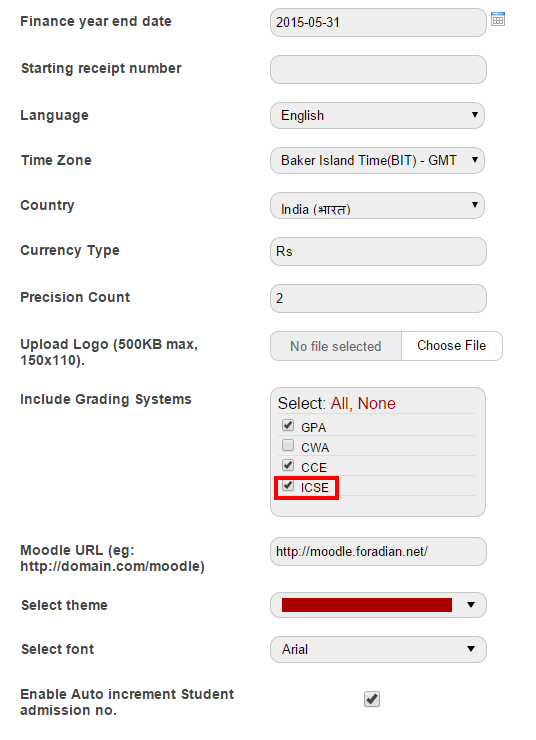
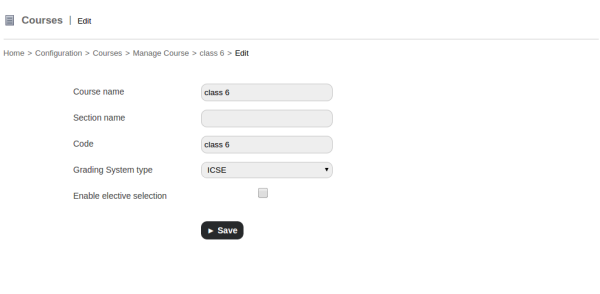
Before you start using the ICSE grading system for examinations in your institution, you need to do some configuration. For this, you need to first go to ‘General Settings’ where you will select ICSE as the grading system.

1

As you can see in the above screenshot, ‘ICSE’ has been selected as one of the grading systems. Before proceeding to the next step you need to upgrade all the relevant existing courses to ICSE grading system.

2
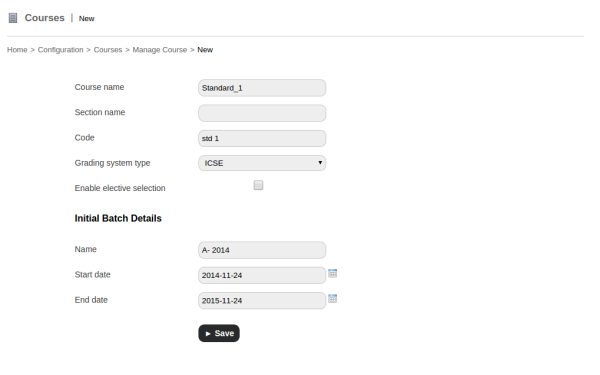
3For all the other new courses, use ICSE as the opted grading system as shown in the screenshot.

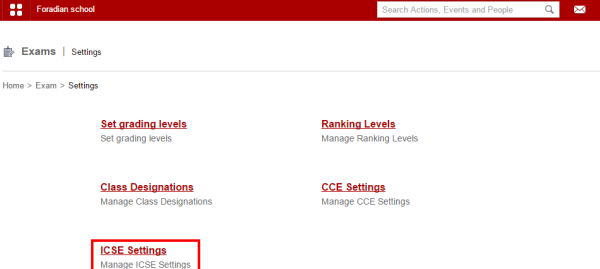
Then comes the part of adding relevant ICSE settings from the Settings part of examination.

4

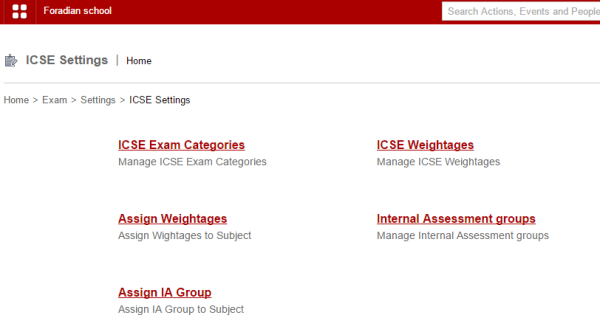
‘ICSE Settings’ will take you to its page where you need to do the configurations.

5

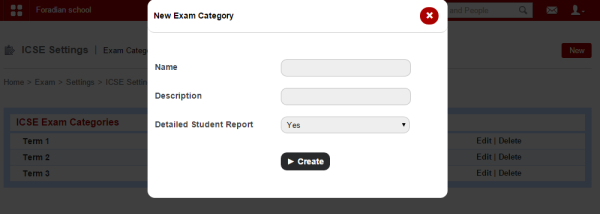
ICSE Exam Categories: This section will let you create new ICSE exam categories. Clicking on the ‘New’ option will let you create new exam categories.

6

Fill in the necessary information to create the new exam category.

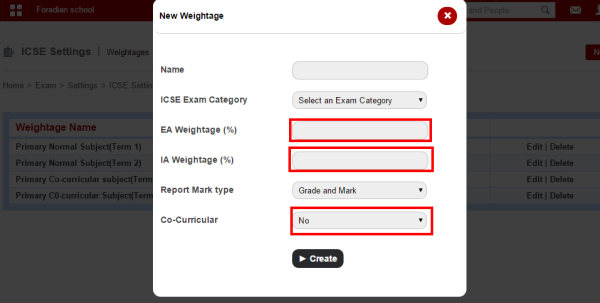
ICSE Weightages: The next step is to create the ‘ICSE Weightages’.

7

Provide with the EA or External Assessment weightage and IA or Internal Assessment Weightage along with option of co-curricular activities (if co-curricular activities are part of any of the weightage.)

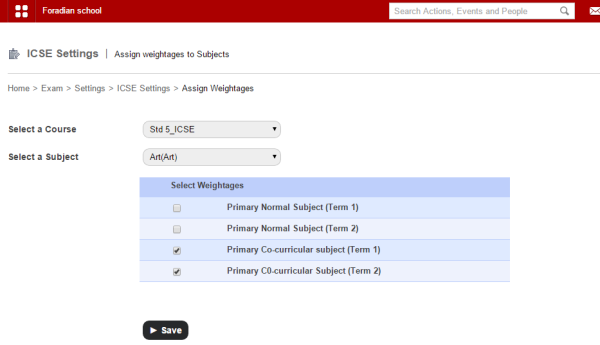
Assign Weightages: The weightages created above has to be assigned to respective batch and for this, you need to select the respective batch and also the subject.

8

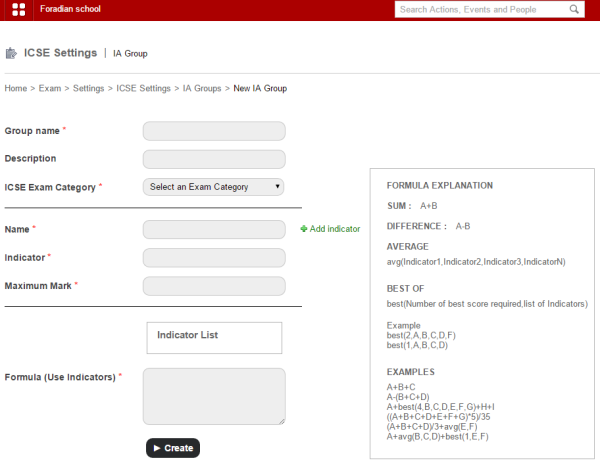
Internal Assessment Groups: Create a new internal assessment group for internal assessment exam.

9

Create the group by filling up the necessary information. Make sure you provide the indicator and the formula. Description of all formula is given in the right-hand side of the page, as shown above in the screenshot.

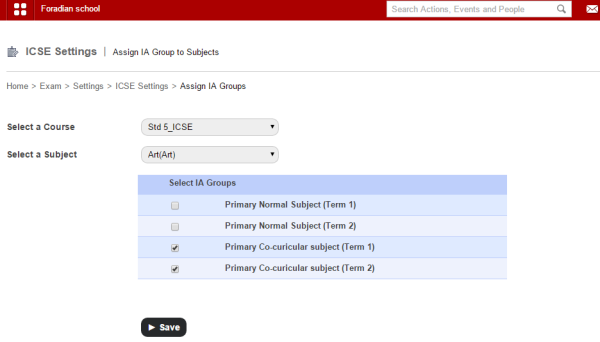
Assign IA Group: Once you are done creating IA group, the next step is to assign the IA group.

10

Assign IA group and you are done with ICSE exam configuration.

In the next article, we will be talking about the ICSE Reports in detail.

What are the Essential Components for Effective E-Learning

E-learning (1)

E-learning is accessing education through educational technology, electronic media, information, and communication technologies. It includes a multiplicity of media, images, animation, video-streaming, satellite, CD-ROM, TV, computer-based learning, intranet/extranet, as well as web-based learning technologies. Both communication systems and information underlie the e-learning process – either on local networks or internet networking. Sometime institutes don’t prefer the e-learning because of the certain expertise skills requirement but with Uzity learning management system you don’t have to worry about any technical expertise. It is the easiest platform all you need just a basic knowledge of working a computer.

 
Institutions
 

The first thing you will need to take into consideration for effective e-learning is the institution you will be using for e-learning. There are many institutions that offer e-learning in different areas of study. However, not all of them are effective in providing this service. If you want to find the best in the industry, you should make use of the following e-learning tips:
 

  • Begin by looking at the reviews provided by previous students about the institution. Positive reviews will mean good performance and negative reviews mean a bad performance.
  • Make sure the institution is accredited by the necessary governing bodies. This will vary from one location to another.
  • Ensure the institution have the courses you want to purse and they are provided at times that are convenient for you. Once you have made sure everything is set, you will need to ensure you have the right hardware requirements.


Requirements

Basically there are two ways you can go about e-learning either by use of internet or compact disk. Both these methods are effective, but they will require different items for them to be effective.


When a compact disk (CD or DVD) is used as the mode of learning, one will require to have a few items. To start with, you will need to have an electronic medium that can be used to play the disk. Since current disks are audio visual, you will need a DVD player and a television set. Alternatively, you can use a desktop computer with speakers or a laptop. Quality speakers are recommended as they will ensure you get the information from the disk in a loud and clear fashion.


Once you have made sure you have the required electronic equipment, you should now search for a good learning environment. Take note that e-learning should be handled just as traditional learning. It is impossible to concentrate in a room where kids are around or in an area that has external noises. If it is hard for you to find a good place to study, you should consider getting a laptop and a pair of headphones. With these items, you can go to a library or a restaurant during your learning hours.


On the other hand, you may find that internet is the mode of e-learning you will be using. In this case, you will need to make sure you have a good computer. Generally, any Pentium four computer that has one gigabyte of memory or more should suffice. However, you will get the best performance from any computer that has a core processing (core 2 duo, core i3 and so forth) and four gigabytes of memory or more. Remember, the faster the computer, the higher the performance.


The next thing to consider is your internet connection. Depending on your location, you should make sure you have a fast and reliable internet connection. Before choosing an ISP (internet service provider), make sure they give you guarantees on their up-times and down-times. The provider with the highest up-time should be considered. Up-times are when the internet connection will be working while down-times are when the same connection will be down. Usually, they provide estimates and inform you when they are undergoing problems or doing maintenance of their system.


Make sure you have the required consultations before you choose to purchase any of the above equipment. You can consult a technician in your area about the computer you will need for your learning process. You may also look at forums on the internet where students talk about computers they use for effective and successful e-learning.


It would also be wise to consult the institution that you will be using for your e-learning. In most cases, they will provide you with the hardware requirements you will need. They will inform you of the best computer to use and what you need to have to make sure your learning process is efficient.

The All New Remarks Module with Fedena 3.3 to Provide Remarks to Students

Remarks_Module

Introducing a new module with Fedena 3.3, Remarks let you provide remarks for each of the student on the basis of performance in different subjects or some common remarks on individual student on any particular exam conducted. The module also allows administrators to provide custom remarks on the students. To know more on the Remarks module, go through the article below.

The Remarks module

The Remarks module can be used in three major forms- as common remarks, subject-wise remarks and custom remarks.

How the three major forms of the module works

A subject teacher or a tutor of the particular batch has the privilege to provide remarks.Subject teachers can add/modify remarks for those subjects which they teach whereas the tutor can add/modify for all subjects in that batch. For this, you need to go to ‘Exam Management’ in ‘Examination’. Select the particular course and the respective exam as well as the subject to provide remarks for each of the student on the particular subject.

4

As you can see, individual marks are given to each of the student in the respective subject.
2.png

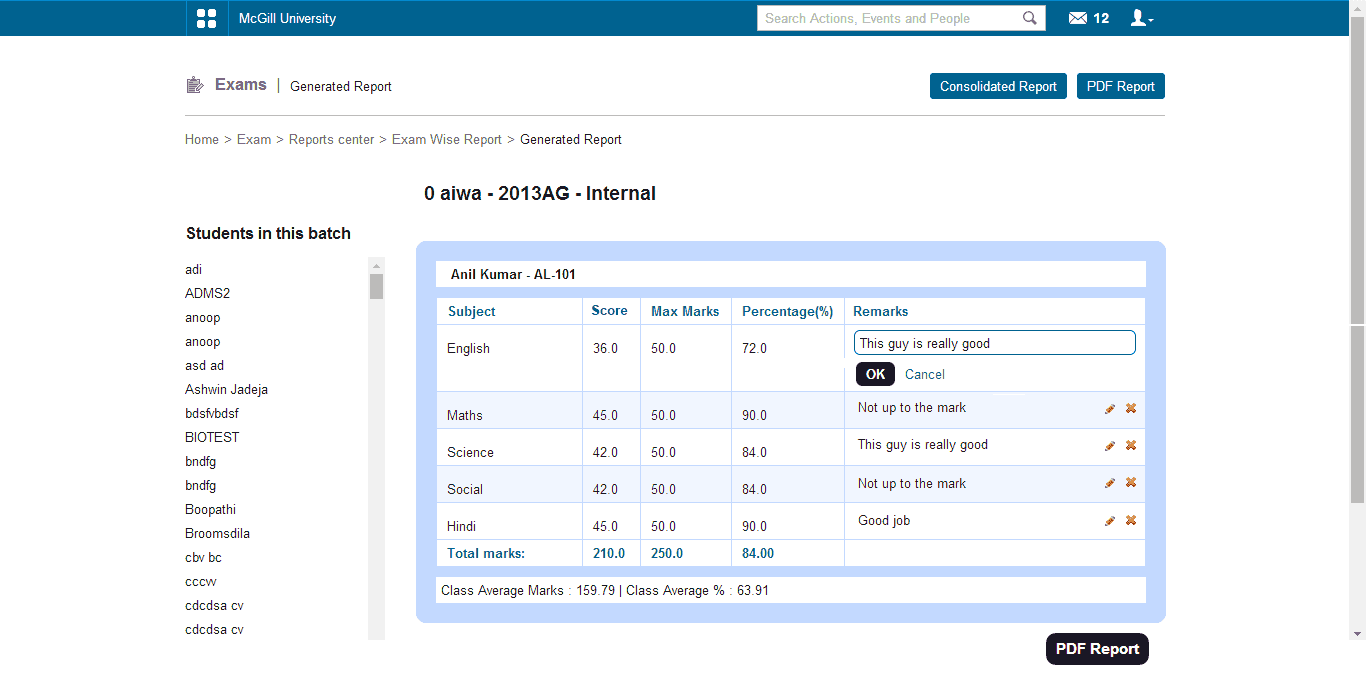
Remarks can also be added for a particular subject from Exam Wise Reports and Student Transcript Page.
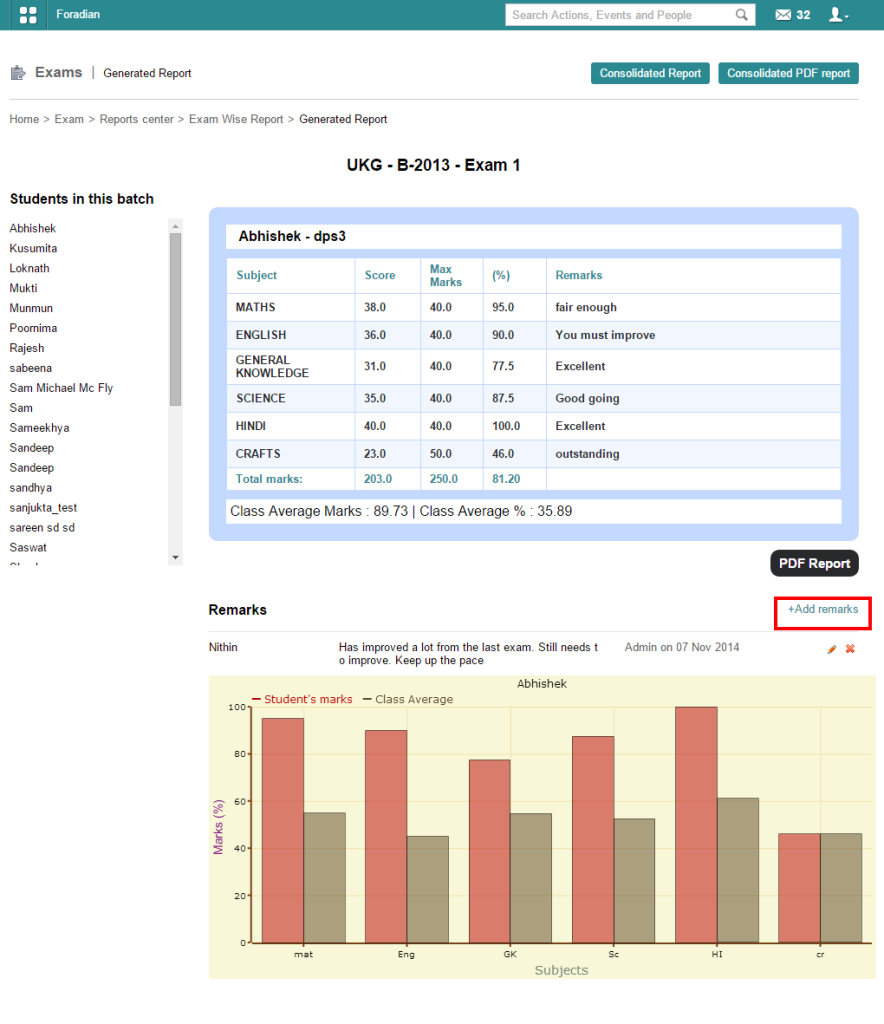
To check the report on remarks based on exams, you have to go ‘Exam Wise Reports’ in ‘Exam’ and select the batch and exam group.
3
The screenshot above shows the subject wise marks of the particular student. For ‘Common remarks’ on the particular students, you have to click on ‘+Add remarks’ as marked in the screenshot, and add your respective remark for the student. ‘Common remarks’ are helpful when you want to provide with extra remarks for any students on the particular exam the student attended.

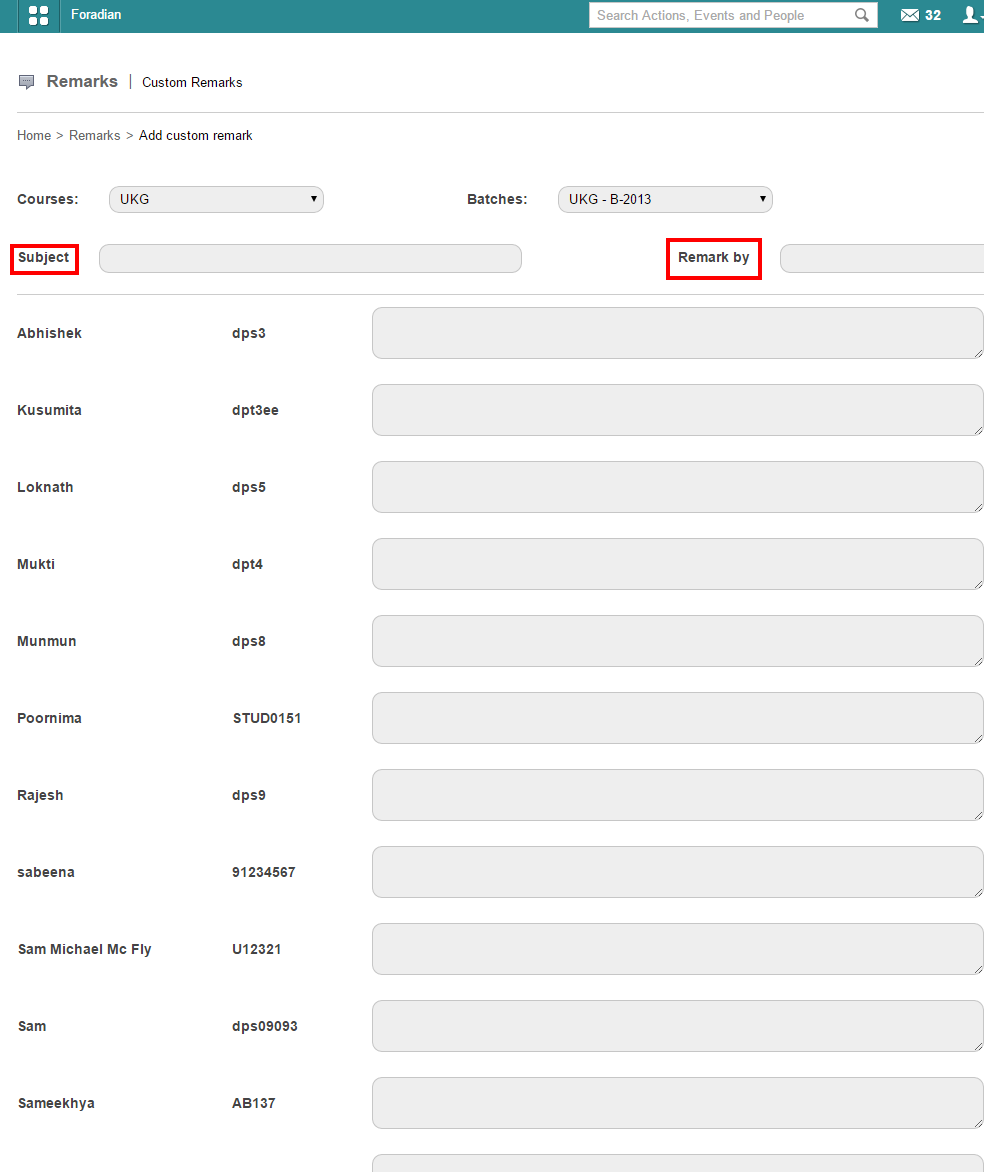
When you are looking forward to provide with custom remarks, you need to go to ‘Remarks’ in ‘Academics’. There is an option to ‘Add custom remark’ which when selected will ask you to select the particular course and batch.

4
For custom remarks, you have to provide the name under whom the remarks are to be published, in the ‘Remark by’ box. Provide with a ‘Subject’ as well before filling up remarks for each of the student. ‘Custom remarks’ are those remarks which are general comments on any student on the overall performance.

PDF report on the remarks can also be extracted.

World Usability Day – Fedena has all Reasons to Celebrate!

Usability-day


How do you define usability? ISO 9241 standard  defines usability as “The extent to which a product can be used by specified users to achieve specified goals with effectiveness, efficiency, and satisfaction is a specified context of use.” What conclusion we can come to is that, usability is all about the ease of use and this ease of use must be defined on the outlines of effectiveness, the ease of learning, the engagement and efficiency it involves. Well, with these characteristics, Fedena is highly usable and its usability is attributed to its features which are especially designed considering users and their context of use in mind. The words of Mr.Anh Pahn from Wellspring International School, a Fedena client,further establishes how Fedena fulfills the characteristics of usability.


“A great user experience. I liked the search engine inside Fedena! Anyone can use Fedena in seconds. Mr.Anh Pahn, Wellspring International School,

When we talk about the usage of a software, an ERP software and its usage is way different from that of most other web software. This is because, the lifeline of usage for most of these web software is limited to once or twice by the given user; whilst, an ERP software is there for a longer time, sometimes, couple of hours a day. Thus, usability takes an important stand when it comes to time span of usage of a software. How will you be comfortable using a software if its not easy to use, simple to learn and highly engaging? Team Fedena works hard to build a better user experience with simplified features in a way that fits the real world context, facilitating users to perform their tasks all the more efficiently with Fedena.


“Fantastic UI, The entire user experience is so fabulous that it makes a lot of sense for students because they are used to that kind of a clutter free design” Mr.Lux Rao, Chief Technical Officer, HP India.


Yes, it is Fedena’s clutter free design and easy to use dashboard that helps Fedena to reach educational institutions of all genre. Fedena’s single dashboard contains all the features, thus users don’t have to migrate to other pages to look for different features. Fedena requires anyone with basic computer knowledge to operate easily, thus allowing customers from diverse age group- a student in the junior class can use it with the same ease as that of somebody from the management body of an institution. This is one point that has taken Fedena to almost all parts of the world, with 40 000+ schools and colleges trust the software to manage their data and 20 million+ students and teachers stay powered by Fedena. The improved UX of Fedena helped us with better user engagement and a sales growth of around 40%. The reason being the growing importance of usability, apart from features as well.


Today, on November 13, 2014, on World Usability Day, we are  confident to claim that Fedena is more usable than it was on November 13, 2013 and it continues in its journey towards evolvement. We, at Foradian Technologies, continue to do our best in making Fedena more usable and our efforts have been acknowledged and received well by a most of our users.


“Fedena with its beautiful and innovative UI/UX design is loved by the teachers and other users of our institutions. It has increased the productivity and efficiency many fold”, Mr.Deepak Reddy, Aditya Group of Institutions, India.


If you are a Fedena user, please feel free to provide your valuable comments or suggestions on the UI/UX of Fedena. We will be happy to know your experience!

What Online Education Can Learn from MOOCs

Mooc

This month, millions of students will start new courses on campuses online. Some will take formal courses from traditional higher education institutions, and some will enroll in one of the hundreds of available MOOCs (there are more MOOCs starting this September than have been available in any previous month). For the most part, students won’t be doing both of the things at the same time—though a few colleges offer MOOCs for credit, not many students have chosen to take them.

But that doesn’t mean that MOOCs and traditional online education are two completely different beasts. In fact, online education can learn a lot from MOOCs, and in fact many online courses are already starting to implement ideas and practices derived from the research on MOOCs.


Here are a few examples of what online education can learn from MOOCs

Content delivery: Lectures and video


Online students have wanted video technology in their courses for years—in response to a 2010 Get Educated poll, 60% of respondents answered “video technology” to the question “Which technology would you like in online classes?” Despite that, many online courses have continued to rely mainly on text-based resources as substitutes for in-class lectures. Why? Perhaps because of a lack of production capabilities, limitations of learning management systems, or even instructors not realizing how valuable video can be in an online course. Or it could be a combination of all three. However, this is all changing because of MOOCs, in which video lectures and tutorials constitute the primary means of content delivery. Now, more online courses are using videos, produced either in-house or by a third-party vendor such as a textbook publisher.


Instructors interested in using video lectures in their courses would do well to consult the MOOC data on the types of videos that are most engaging for students. In particular, MOOC researchers have found that the ideal length of a video lecture is between 6 and 9 minutes, informal talking head–style videos are more engaging than PowerPoint slideshows or screencasts. Video lectures designed for online consumption are better than recorded live lectures, a fast speaking rate leads to higher engagement, which is in contrast to live lectures, in which pauses are often deliberately inserted, and students usually watch video lectures only once, but re-watch and jump around in video tutorials.These findings are just as applicable to preparing content for for-credit online courses as they are for massive open ones.

Assessments and activities: More is better

MOOCs in general have more activities and more assessments than are found in traditional in-person and online classes.Most MOOCs involve not only very short lectures, but also assessments within and between lectures. For example, in some MOOCs review questions are interspersed in the videos and every module segment ends with a short quiz. These assessments are not always graded, but they do serve to enhance student engagement and understanding, and this style is starting to be used more frequently in formal online education.

In addition, MOOCs have been innovative in supplying opportunities for students to exercise their problem-solving muscles. According to Columbia University’s Fiona Hollands, based on MOOC research instructors are incorporating more problem-solving activities into their traditional courses, which has resulted in improvements in student performance.

The value of instant feedback

Most MOOCs provide students with instant feedback on their activities and assessments. Automated grading systems are able to tell students immediately where they are going wrong and set them on the right track, not just for multiple choice questions, but also for things like coding and even (controversially) essays. EdX President Anant Agarwal sees this feedback as having “a huge value,” saying: “Students are telling us they learn much better with instant feedback.”

Agarwal’s words are proving more and more true as new data come available. Even in the controversial area of writing, there is evidence that instant machine-scoring feedback is beneficial. Since 2009, instructors at the New Jersey Institute of Technology have been using an automated essay grader, not as a final grading system, but as a sort of writing tutor. In doing this, they have found that students are much more willing to rewrite and revise their work in response to computer feedback than human feedback.

Instant feedback is nearly impossible in an on-campus course (at least one of any size), and it is not something that has typically been strived for in online courses either. However, with the improvements in machine grading systems, online instructors may soon be able to provide instant feedback as a matter of course.

MOOCs are not right for every course or every student, but they still have value, and that value is not limited to the classes themselves. MOOCs and the analytics that are being used in them have great potential to inform teachers about how students learn and what works best in classrooms, both online and off. Rather than dismissing or overlooking them, we should focus on what we can learn from them—a process that has only just begun.


The article is written by:

 

sameer-bhatia-g+Sameer Bhatia, founder & CEO of ProProfs, a leading provider of online learning tools for building, testing, and applying knowledge. ProProfs Knowledge Base Software is used to create highly-searchable online FAQ’s to improve customer service and reduce tickets. Sameer has a Master’s degree in Computer Science from the University of Southern California (USC) and is an ed-tech industry veteran. You can find him on Google+ and Twitter.